

Cause of male pattern hair loss – is the answer to be found in the face?
Cause of male pattern hair loss – is the answer to be found in the face?
Hypothesis: increased muscle tone of the facial and masticatory muscles as a result of psychophysiological conditioning (stimulus-response pattern) caused by interpersonal interaction

Theory/Hypothesis:
The special role of the face as a body part is taken into account in order to indicate a psychophysiological phenomenon that is possibly causative for male pattern hair loss:
In modern, anonymous, populous societies, the face (especially the mouth, eyes, eyebrows) is the primary tool for interpersonal communication, interaction, and identification. A wrong or inappropriate facial expression can have serious, life-threatening consequences – depending on the situation:
Example 1 (exaggerated): a wrong facial expression in an area characterized by crime and violence → physical attack by easily provoked/violent individuals → injury/death
Example 2 (exaggerated): a wrong facial expression in a job interview → no job → no income → no money for food → hunger/death
Through interpersonal mimic and verbal interaction, humans are conditioned since birth to have their facial expressions under control so as not to provoke unwanted/wrong interpretations and associated reactions from their fellow humans that could have a detrimental effect on their lives in the short or long term, directly or indirectly. The basis for this conditioning is the association of emotion and facial expression anchored in the human mind or predefined by society. Each emotion is assigned a corresponding facial expression. It is a widespread assumption that a person’s facial features (facial expressions) basically represent his or her emotional state at all times, since everyone has adjustable facial expressions. This means, for example, that when someone relaxes his/her facial muscles, his/her face, and thus he/she as a person, then also makes a relaxed or neutral impression on other people.
“Problem”: some people have a facial shape that does not make a relaxed or neutral impression on other people when physically relaxed. These people are consciously or unconsciously conditioned through interpersonal mimic interaction, but also through verbal communication, to keep their facial and masticatory muscles permanently in tension in order to be able to adjust their facial expression if necessary, since their physically relaxed face triggers undesirable/wrong interpretations and associated reactions in other people. This permanent, subliminal tension (increased muscle tone) of the facial and masticatory muscles possibly sets off a chain of effects that ultimately causes hair loss.
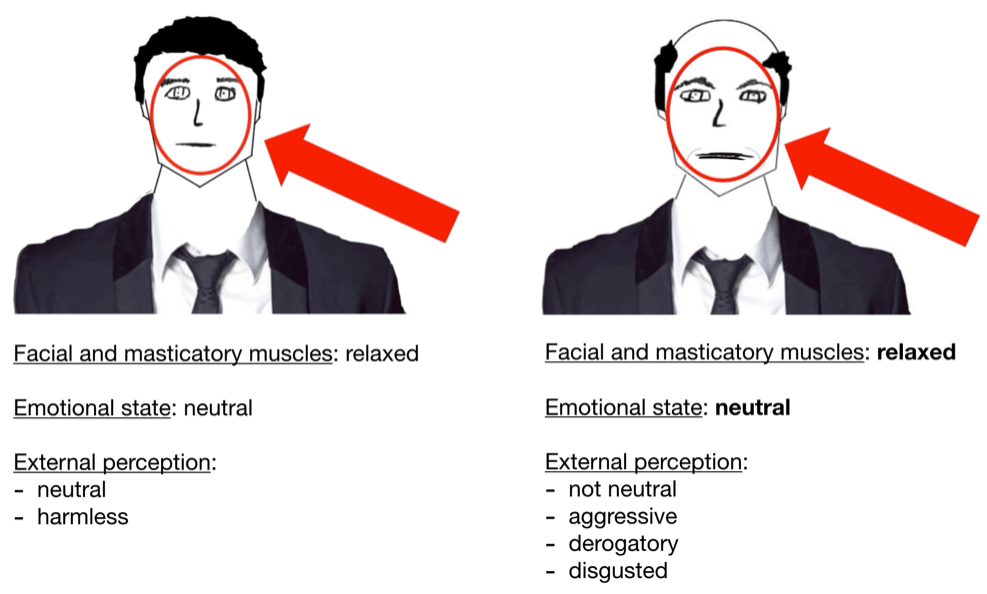
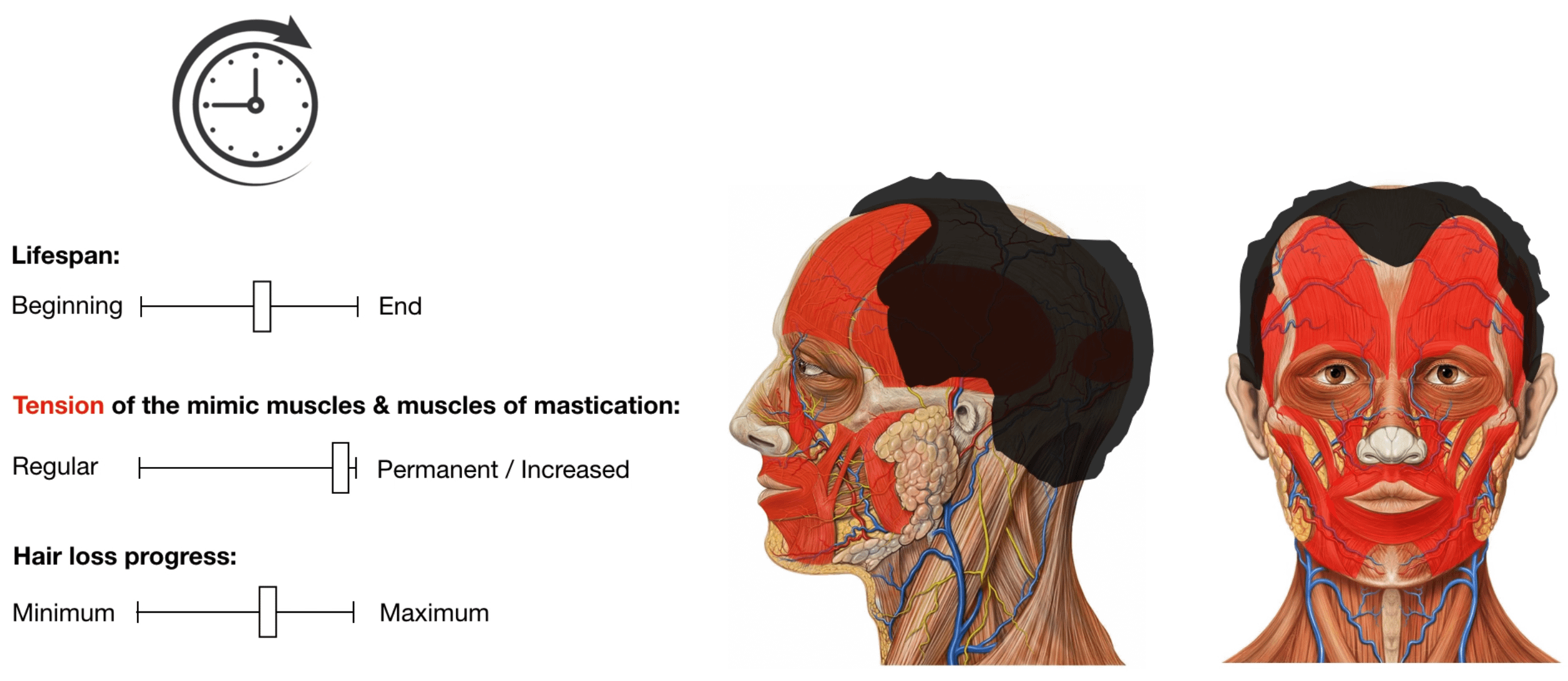

Video – hair loss and tone (contraction) of the mimic and masticatory muscles as a function of time:
3D model of mimic musculature: https://sketchfab.com/3d-models/mimische-muskulatur-cc7a87967e974eb2862bc4118335dfce
3D model of masticatory muscles: https://sketchfab.com/3d-models/kaumuskulatur-975fcebfd5ba47ca856e54c07ce3523b
3D model of half head without skin: https://sketchfab.com/3d-models/half-of-a-head-without-skin-515c6f9c71784996bfab4fdb80ef0ad9
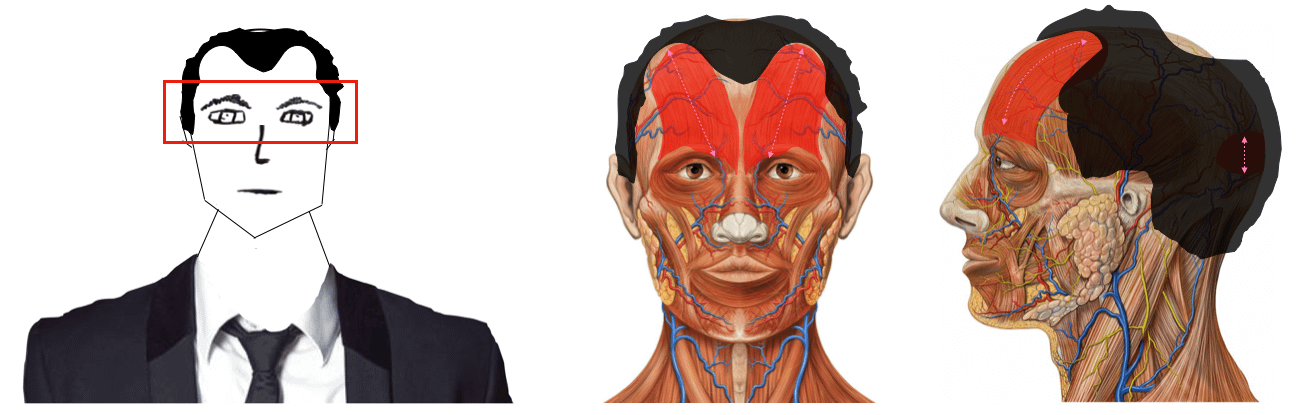
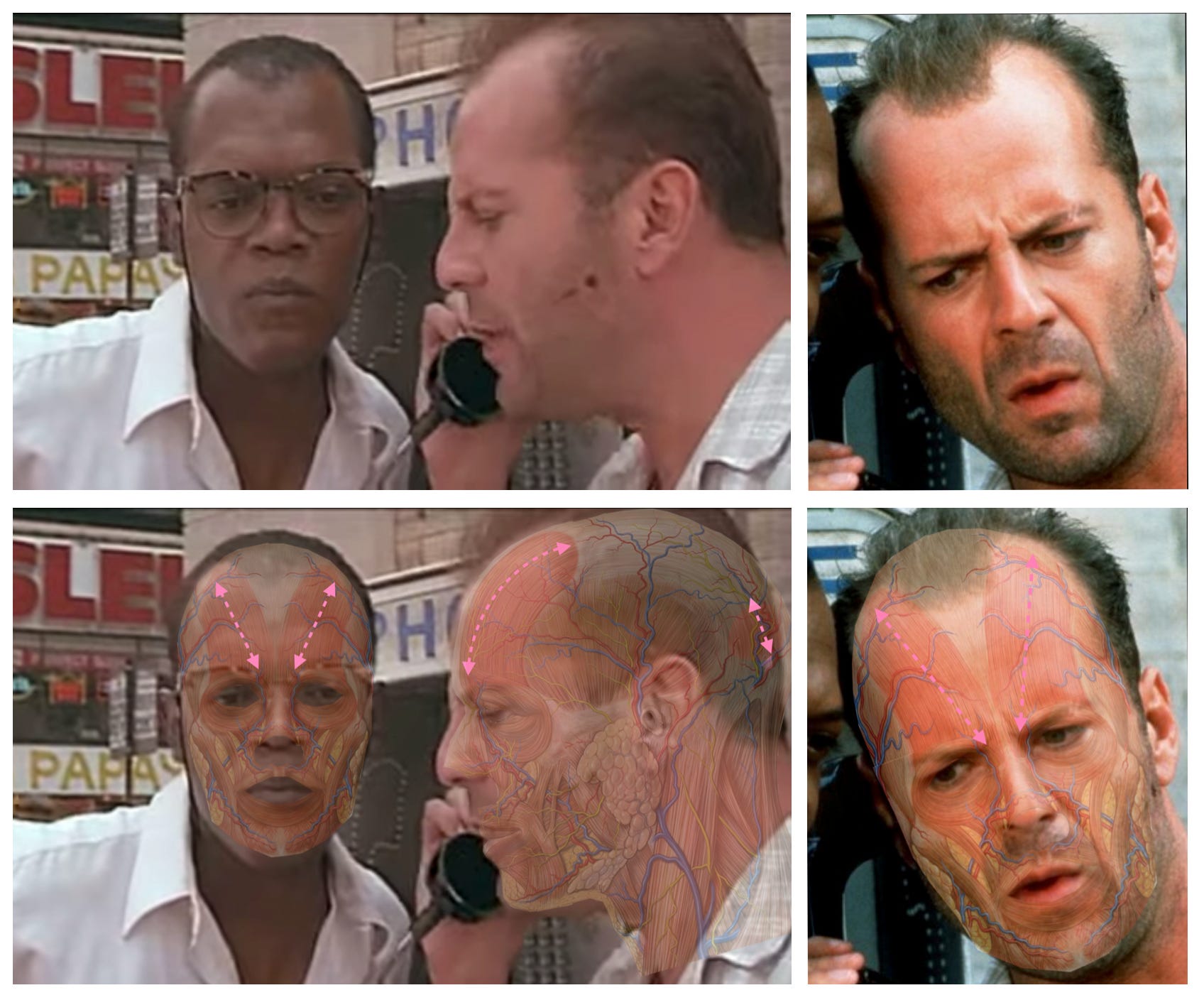
Example 1 (hair loss in the forehead and temple area):
In a man with eyes that appear “piercing” to outsiders or an eye area that appears threatening or irritating, a permanent, subliminal tension of the following muscles arise (increased muscle tone):
Musculus frontalis (function: frowning, raising the eyebrows)
Musculus occipitalis (function: smoothing the forehead)
Musculus corrugator supercilii (function: pulling down the eyebrow, wrinkling the forehead)
The final result of the increased muscle tone of the mentioned muscles is hair loss in the forehead and temple area. Because of the connection to the galea aponeurotica, hair loss can also occur on the vertex and tonsure. Simultaneous tension (increased muscle tone) of the above-mentioned mimic muscles is not necessarily visible in a person’s facial expression – just as, for example, the biceps and triceps can be tensed at the same time and the arm can still hang down and make a relaxed impression on outsiders. Because the muscle tone of the aforementioned muscles builds up over time and is in a subliminal range, it is not necessarily noticed by the affected person.
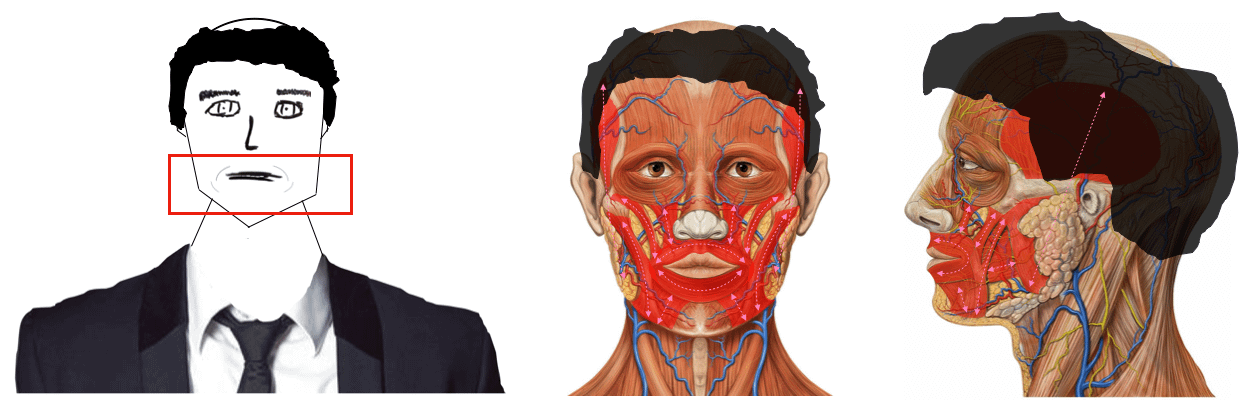
Example 2 (hair loss in the tonsure area – at the crown of the head):
In a man with a slightly open and slanted mouth in a physically relaxed state, and partially visible teeth – which in combination can have a threatening or irritating impression on surrounding people – a permanent, subliminal tension of the following muscles arise (increased muscle tone):
Musculus buccinator (function: pressing the jaws)
Musculus orbicularis oris (function: contraction of the mouth opening)
Musculus depressor anguli oris (function: lowering the corner of the mouth)
Musculus risorius (function: lateral and headward movement of the corner of the mouth, retraction of the dimple of the cheek – laughing muscle)
Musculus zygomaticus (function: pulls the corner of the mouth up and back – smile muscle)
Musculus levator labii superioris (function: lifting the upper lip)
Musculus depressor labii inferioris (function: lowering the lower lip)
Musculus levator anguli oris (function: lifting the corner of the mouth)
Musculus masseter (function: lifting and lateral movement of the lower jaw)
Musculus temporalis (function: jaw closure, retraction of the lower jaw)
Musculus pterygoideus medialis (function: lifting of the lower jaw, jaw closure)
Musculus pterygoideus lateralis (function: opening of the jaw, advancement of the lower jaw, grinding movements from right to left or vice versa)
Musculus mylohyoideus (function: opening the mouth, raising the hyoid bone)
Musculus geniohyoideus (function: advancement of the hyoid bone – involved in mouth opening)
Musculus digastricus (function: opener of the oral fissure – involved in mouth opening)
The final result of the increased muscle tone of the mentioned muscles is hair loss in the tonsure area (at the crown of the head).

Questions and answers (assuming the theory is correct):
Q: What could be the chain of effects triggered by the increased tone (chronic contraction) of the facial and masticatory muscles that ultimately leads to hair loss?
A: The consequence of the extraordinary tension (increased muscle tone/chronic contraction) of the muscles mentioned could be an increased regional tension of the scalp and the galea aponeurotica (a) and/or a direct permanent squeezing of blood vessels by the tensed mimic muscles and the masticatory muscles (b) and/or a malposition of the mandible (c).
(a) The consequence of the increased regional tension of the scalp and the galea aponeurotica could be inflammatory processes. Chain of effects: Inflammation → DHT at scalp sites → TGF beta 1 → scarring of the hair follicles → hair loss.
(b) The consequence of a direct squeezing of blood vessels by the tensed mimic muscles and the masticatory muscles could be a disturbance of blood circulation and thus an obstruction of the removal of metabolic products from the scalp sites. The assumption is that especially the veins (function: blood backflow to the heart) are affected. Chain of effects: Accumulation of metabolic products at scalp sites → Inflammation → DHT at scalp sites → TGF beta 1 → scarring of the hair follicles → hair loss.
(c) The consequence of a malposition of the mandible could be a squeezing of blood vessels, whereupon a regional circulatory disturbance occurs, i.e. an obstruction of the removal of metabolic products from the scalp sites. Chain of effects: Accumulation of metabolic products at scalp sites → Inflammation → DHT at scalp sites → TGF beta 1 → scarring of the hair follicles → hair loss.
The assumption is that the degeneration process (a/b/c → scarring of the hair follicles) takes place over a period of about 5 to 20 years, until the function of the hair follicles is so severely impaired that there is clearly visible hair loss. The basis for this assumption is the observation of people with transplanted hair, whereby the transplanted hair follicles – contrary to common claims – are apparently also affected by the described degeneration symptoms after a certain time.
Q: How can the Norwood hair loss pattern be explained?
A: The Norwood hair loss pattern is the direct or indirect result of the tension created by the mimic and masticatory muscles. The effects of increased muscle tone (the hair loss pattern) are additionally influenced by the anatomy (e.g., shape of the skull, shape development and position of muscles and blood vessels, thickness of the galea aponeurotica, skin structure).
Q: How is hair loss "inherited"?
A: Head and face shape is genetic. The facial features of a son resembles the facial features of his father and mother. Due to the similar facial features, the son is subject to the same subconscious psychophysiological conditioning process, which leads to similar tensions (increased muscle tone/chronic contraction) and, as a result, to a similarly hair loss pattern. Because facial expressions are learned by imitation, and parents spend most of their time interacting with their children during the first years after birth, parent-infant interaction could contribute significantly to the psychophysiological conditioning described above.
Q: Why are significantly more men than women affected by pattern hair loss?
A: The conditioning (establishment of psychophysiological reflex → increased muscle tone) that leads to hair loss in men does not lead to hair loss in women because of the different physiology (e.g., different skin structure, thinner skin, thinner galea aponeurotica, lower muscle mass and strength, different skull shape).
Q: How can the alleged successes due to the use of muscle relaxants in the face be explained?
A: The muscle relaxants injected into the face and scalp relax parts of the mimic muscles and the masticatory muscles, which partially relaxes the described muscle tensions that ultimately lead to hair loss.
Q: Why does transplanted hair grow?
A: Pattern hair loss is thought to be the result of a degeneration process that takes place over several years. With a hair transplant, healthy tissue is transplanted along with it, so the degeneration process – which can take up to 20 years before there is clearly visible hair loss – only starts after the transplantation.
Q: Why does hair loss in identical twins (same genetic makeup) develop differently?
A: It is possible that the twins grew up in different environments: different number of interpersonal interactions and different sensitivity of the twins and surrounding people to facial expressions. The result would be a different degree of psychophysiological conditioning (differently increased muscle tone) and consequently a different progression of hair loss.
Q: Why are isolated/uncontacted groups (hunter-gatherers) not affected or less affected by pattern hair loss?
A: They are usually smaller, non-anonymous groupings of people where everyone knows everyone else from birth and interacts with each other, making facial expressions and the need to adjust and interpret them less important. The necessary framework conditions for the described psychophysiological conditioning that leads to hair loss are therefore not given. So if the theory is correct, pattern hair loss could also be described as a disease of an anonymous and populous society. In the modern, anonymous societies, in which people are usually clothed up to the head, the focus during interaction is furthermore mainly on the face or the head, which possibly intensifies the described psychophysiological conditioning.
Q: What are the possible reasons for the “failure“ of research into the cause of pattern hair loss?
A:
Pictures of faces are largely useless as a basis for a pattern recognition because people taking pictures of themselves or being photographed by others usually adjust their faces. It is rare to see physically relaxed faces in pictures. This is equally true when observing the facial features of the people surrounding one, where physically relaxed faces are also rarely seen.
The impression that facial features have on an outside person is something very subjective, making pattern recognition difficult.
A person's sensitivity to other people's mimic and verbal reactions to their own facial features is something very subjective, making pattern recognition difficult.
Refutation of the theory:
Persons who are completely blind and completely deaf since birth should be less or not at all affected by pattern hair loss, since the described conditioning (establishment of psychophysiological reflex → increased muscle tone) occurs mainly due to the visual and the acoustic perception of the reaction of outside persons (note: deaf-blindness often does not mean the complete loss of hearing and vision). A person who becomes completely blind and completely deaf at, say, 5 years of age is not suitable for refutation. A person who is totally blind and totally deaf since birth but who was previously able to recognise facial features or understand the spoken word by means of technical devices is not suitable for refutation. It must be ensured that the person’s hair loss is not due to another condition. If the group of people mentioned is not less affected by pattern hair loss, the theory is refuted.
Measurement of the muscle tone of the mimic and masticatory muscles of men affected by pattern hair loss (age > 30 years) and measurement of the muscle tone of men of the same age who are not affected by pattern hair loss. Both groups have to set their – in their opinion – neutral (relaxed) facial expression for the measurement. If no increased muscle tone is found in the men with pattern hair loss, the theory is refuted.
Relaxation of the mimic and masticatory muscles of men affected by pattern hair loss using muscle relaxants over a period of > 6 – 12 months. If this measure has no effect on hair growth, the theory is refuted.
Other perspectives (theories) worth seeing:
Craniofacial development:
https://tmdocclusion.com/home/connection-to-other-diseases-and-syndromes/hair-loss/
https://tmdocclusion.com/2018/07/14/more-on-hair-loss/
Malocclusion:
Skull Expansion: